
Contents
Overview
The concept of Continuous Integration (CI) was first articulated by Grady Booch in 1991, though his initial vision focused on integrating code changes less frequently than the modern practice. The underlying principle, however, was to mitigate the risks associated with large, infrequent merges. Early CI systems were often custom-built scripts and internal tools within pioneering companies like Microsoft and Google. Version control systems like Subversion and later Git provided the necessary foundation for automated integration. Martin Fowler's influential writings in the early 2000s helped popularize the term and its associated practices. The development of open-source CI servers such as Jenkins (originally Hudson) democratized access to CI, making it feasible for teams of all sizes.
⚙️ How It Works
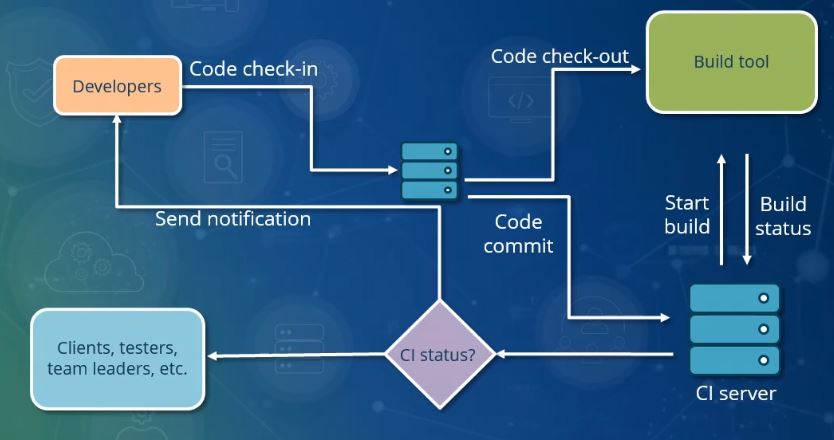
Continuous Integration tools operate by monitoring a central code repository, such as GitHub or GitLab, for new commits. Upon detecting a change, the CI tool orchestrates a series of automated steps: fetching the latest code, compiling it, running unit tests, and often performing static code analysis. If any of these steps fail, the tool immediately notifies the development team, typically via email, Slack, or within the repository interface itself. Successful builds are then often passed to subsequent stages, such as Continuous Delivery (CD) pipelines for further testing or deployment. Key components include build servers, agents, and integration with testing frameworks like JUnit and Pytest.
📊 Key Facts & Numbers
Globally, the CI/CD market was valued at approximately $2.5 billion in 2022 and is projected to grow at a compound annual growth rate (CAGR) of over 15% through 2030. Companies report that implementing CI can reduce integration problems by up to 75%, leading to a 20-30% decrease in bug-fixing time. On average, a CI server can perform hundreds of builds per day for a medium-sized team. The adoption rate of CI/CD practices is highest in industries like finance (95%) and e-commerce (92%), with even traditionally slower-moving sectors like healthcare seeing adoption rates exceeding 70%.
👥 Key People & Organizations
While CI tools are often developed by large organizations, the open-source community has been instrumental. Jenkins was originally developed as Hudson at Sun Microsystems before becoming an independent open-source project under the Apache Software Foundation. GitLab offers a tightly integrated CI/CD solution within its DevOps platform, developed by its own engineering teams. GitHub Actions has rapidly gained traction since its release, leveraging GitHub's massive developer base. Companies like CircleCI and Travis CI also provide popular cloud-based CI services. Key figures like Martin Fowler have been influential in defining and promoting CI best practices.
🌍 Cultural Impact & Influence
Continuous Integration tools have fundamentally reshaped software development culture, shifting the emphasis from infrequent, high-risk integration events to frequent, low-risk, automated ones. This practice is a cornerstone of DevOps culture, breaking down silos between development and operations teams. The immediate feedback loop provided by CI empowers developers to take greater ownership of code quality and stability. It has also influenced the design of programming languages and frameworks, encouraging modularity and testability. The widespread adoption of CI has led to a perception that manual integration is an outdated and inefficient practice, akin to manual memory management in programming.
⚡ Current State & Latest Developments
The CI landscape is continuously evolving with a focus on speed, security, and intelligence. Cloud-native CI solutions are becoming increasingly prevalent, offering greater scalability and ease of management. There's a growing emphasis on security testing within CI pipelines, often referred to as DevSecOps, integrating security checks earlier in the development lifecycle. AI and machine learning are beginning to be applied to CI, for instance, in predicting build failures or optimizing test execution order. Platforms like GitHub Actions and GitLab CI are constantly adding new features and integrations, pushing the boundaries of what's possible with automated workflows.
🤔 Controversies & Debates
The optimal frequency of integration is a persistent debate. While the ideal is often cited as 'multiple times a day,' some argue that for very large or complex projects, this can lead to excessive build times and context switching. Overly extensive test suites can bog down the CI pipeline. The 'build-breaking' nature of CI can halt the work of an entire team, leading to frustration if not managed effectively. Furthermore, the security of CI/CD pipelines themselves is a growing concern, as compromised tools can lead to widespread vulnerabilities.
🔮 Future Outlook & Predictions
The future of CI tools points towards even tighter integration with the broader software development lifecycle, extending beyond just build and test. Expect to see more sophisticated AI-driven optimizations, such as intelligent test selection and automated root cause analysis for failures. The integration of CI with Infrastructure as Code (IaC) tools will likely deepen, enabling fully automated provisioning and deployment pipelines. Furthermore, as edge computing and distributed systems become more common, CI tools will need to adapt to manage complex, multi-environment build and test scenarios. The trend towards 'CI for everything,' including documentation and machine learning models, is also expected to accelerate.
💡 Practical Applications
Continuous Integration tools are applied across virtually all software development projects, from small startups to enterprise-level applications. They are crucial for web development, mobile app development, game development, and embedded systems. Specific use cases include ensuring that new features don't break existing functionality, validating code quality before merging, and providing a reliable baseline for continuous deployment. For example, a team developing a React web application might use CircleCI to automatically build and test their frontend on every push to a feature branch, ensuring compatibility with their Node.js backend API. Similarly, a game studio might use a CI tool to compile game assets and run performance tests.
Key Facts
- Category
- technology
- Type
- technology